
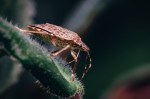
Yesterday, like nearly every other Saturday for the past six months, I vacuumed the living room. It’s a small living room in a small apartment, so it rarely takes longer than the length of a song to complete. As I extended the vaccum to ingest the pile of cat hair in the corner of the room, I noticed a small stink bug lying under the ball of gray fluff. I turned the machine off and prodded the bug with my finger. Though it skirted across the long-pile carpet, it remained on its back, brown legs crisscrossed over the center of its abdomen. It was dead. I picked it up and held it in the palm of my hand for a moment, trying to decide whether I should toss it in the trash or the toilet or a nearby plant.
The average stink bug lives between 6 and 8 months. They have more perceptual pathways than humans: they see, hear, taste, smell, and perceive ultraviolet light. Like us, they communicate using vibrations. But rather than vibrating their larynx, they twist and move their abdomen to generate communicative vibrations.Their nervous system bears a striking resemblance to our own. They have the capacity to learn and to feel pain.
If you google “stink bug,” you’ll notice that references to the bug most often include the modifier “pest.” “Pest” describes an animal or plant that attacks crops, livestock, or other entities of human interest. The stink bug feasts primarily on fruit. To eat, the stink bug inserts its straw-like appendages into an apple or peach, and draws the sugar water from the fruit up to its tiny mouth. The problem is that by dehydrating the fruit, the stink bug renders it unfit for sale. It is this quality – that fruit eaten by a stink bug cannot be sold for profit – that renders it a pest.
Native to Western Asia, the stink bug is believed to have been accidentally introduced to the United States in the mid 1990s. By 2000, residents in Allentown, Pennsylvania were complaining of scores of stink bugs entering their homes to escape the cold winter temperatures. The stink bugs likely found their way to the US after warming in cargo containers carrying manufacturing goods that were shipped from Western Asia to Allentown.
A booming manufacturing center for nearly a century, Allentown was home to companies like Mack Trucks and Western Electric. Like many rust belt cities, by the 1980s, an increasing number of Allentown’s factories closed or relocated out of the country. Paving the way for the mass exodus of US manufacturing jobs, GE CEO Jack Welch famously said that a CEO’s fidelity was primarily to the stockholders, not employees. Welch thought the ideal factory would be on a barge that could be moved to wherever the cheapest labor could be exploited and the greatest profit could be gained. In the decade following civil rights legislation that attempted to outlaw discriminatory hiring practices, neoliberal economic policies incentivized the abandonment of US labor in favor of exploiting workers overseas.
The growth of “invasive species” like the stink bug parallels the growth of neoliberal economic policies and practices that increasingly favored global trade over local production. Coined by zoologist Charles Elton in 1958, the phrase “invasive species” has an obvious militaristic connotation. After World War II, Elton turned his attention to what he called “invasive ecologies.” Up until Elton’s work, the rapid growth of a non-native species in a local ecology was considered an anomaly. While Elton aptly demonstrated how human trade practices were disturbing the harmony developed in indigenous ecosystems, the term directs blame and ire onto the species being transported, rather than human activity.
For example, stink bugs are often depicted as having “hitched a ride” to the United States. The phrase “hitch a ride” usually refers to a person who is trying to get from one point to another without expense, to receive the benefits of someone else’s free labor. It’s an odd phrase to ascribe to the stink bug – or any non-native species, as if they were hoping to acquire some uniquely American benefit for free. Surely stink bugs are not aware of geopolitics, nor the self-aggrandizing narrative of US exceptionalism. Casting the stink bug as the villain is, in the end, ironic, given the on-going histories of wealth extraction practiced by the state and private companies like GE, alike. It seems more likely that the stink bug, not knowing that it’s home – a shipping container – would be sent thousands of miles across 3 oceans to the other side of the world, was trapped, and simply made a life where it landed.
The colloquial name, “stink bug,” gestures toward its villainous status. But the truth is, the stink bug doesn’t actually have a particularly unpleasant odor. It smells more like coriander than anything else. A plant from Western Asia, coriander is derived from the seeds of the coriandrum sativum plant and is commonly used in curries and chutneys. To say that something stinks, is, of course, to say that it smells badly. But anyone who has passed along a wonderfully scented pine candle to a loved one knows that smell is not objective. What smells wonderful to me may smell horribly to you. Often, this is simply a matter of personal preference. But it can also be a dehumanizing tool.
Let me explain. Disgust – the guttural revulsion that we feel in response to rotten food – is an evolutionary olfactory development meant to protect us from sickness and infection. Because disgust is so deeply connected to smell, it can be easily weaponized to apply to smells not associated with rotten food, but with people labeled as rotten. In this way, smell plays a vital role in fostering racism and xenophobia. It is no surprise, perhaps, that in a nation that has systematically excluded Chinese immigrants from acquiring citizenship, incarcerated hundreds of thousands of Japanese Americans during World War II, and continues to foster anti-Asian sentiment, the smell of a common Asian spice would be rendered a stench.
Bearing witness to loss means bearing witness to life, which requires a willingness to sit with the discomfort that arises from acknowledging the complex, sometimes violent, often asymmetrical relationships that shape our contemporary world. And also, then, contemporary losses.
As I gently cupped the tiny stink bug, shifting it from one hand to another, I recalled what seemed like dozens of stink bugs that lined my dining room window last summer. I had just moved back to Milwaukee and I was alarmed by seeing so many of these winged creatures crawling around my apartment. I took the afternoon and relocated as many as I could to my porch. I’m not sure it had any effect.
Still, throwing the stink bug away didn’t feel right. It is just a bug, I thought. But like all 21st century fauna, caught in the matrix of globalization and xenophobia. And probably also by my cat, another “invasive species.” Out of place, but adapting to make a life nevertheless. I slide the tiny thing from my palm into the dirt of a nearby spider plant.
 gardenofloss.com